The CEO Can’t Call the Help Desk
A few months ago I was running a session for the senior leadership team of a company whose name is on products in your house. The CTO asked everyone to open the desktop app we'd be working in.
When the CEO couldn't find the feature the CTO was pointing him to, he got a little frustrated trying to navigate the app. Ten minutes went by. Finally the CTO said, "Can we just share your screen?" — and only once his desktop was up in front of the entire leadership team did the CEO realize that not only was he not in the app, but worse, he'd never even installed it.
True story. And I don't mention it to spark embarrassment. I tell it because I had assumed he was ahead. So did the CTO. Everyone in the room had.
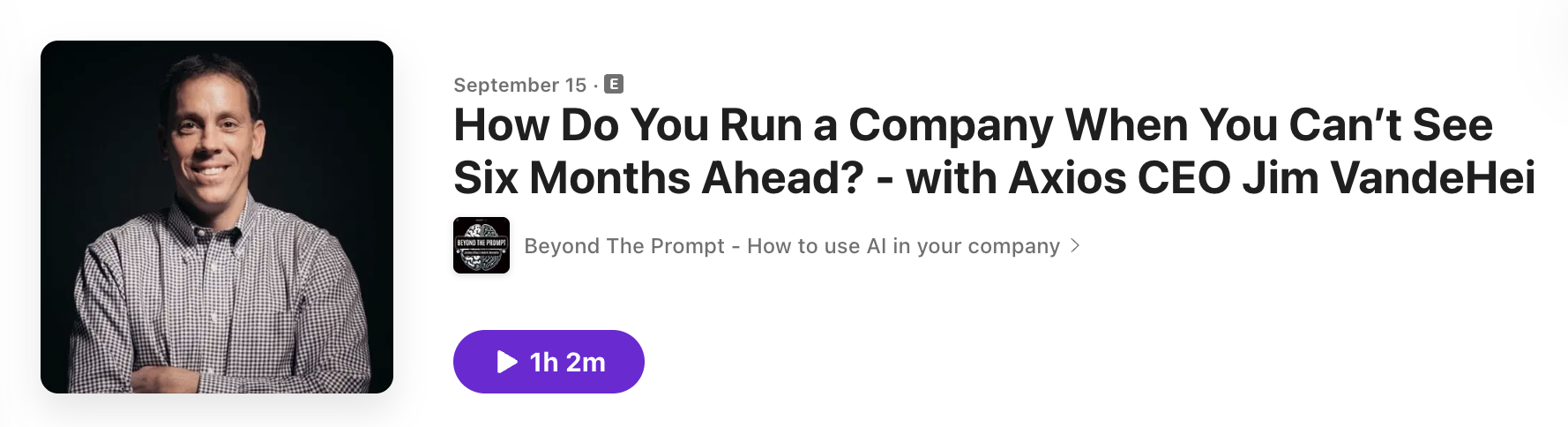
Last week Jim VandeHei, co-founder and CEO of Axios, joined me and Henrik on Beyond the Prompt. Jim had written a column called "Confessions of an AI Lab Rat" that had caught both our attention, and I asked him what surprised him most about how the piece was received.
His first insight? "There's a lot of CEOs who I would've assumed were more AI savvy than they actually were." Tell me about it.
He now writes a newsletter for CEOs about how to think about this technology. Thousands of them read it. Quietly.
Beyond the Post-it
Last week I wrote about the cheapest leadership tactic I know: a four-word Post-it on your monitor that says Have you tried AI? It reminds you, it hands you a question, it gives your team permission, and it fills your story reservoir. Costs nothing.
The Post-it works one conversation at a time, though, and only when you're in the room. This week I want to share four tactics that go further, taken from two leaders I admire: Jim, and my friend Kim Scott. They build the same two things the Post-it does (capacity for the leader and curiosity in the organization) but they keep working when the leader isn't in the room. And not one of them requires her to be the smartest person in the building about AI.
That's actually really important. Jim described why so many CEOs are behind: "They got the job because they were great at sales, great at operations, great at something specific. They've always had a CTO. And this is a new skill set." I'd add one more reason. A CEO can't call the help desk. Everyone else learns a new tool by asking the person next to them and saying "I don't get it" out loud. A CEO who says that about the thing she's told everyone is the future of the company changes the temperature of the room. So she fakes it, or she delegates it. I've watched both (most recently in the aforementioned screen-sharing incident).
Jim did neither.
Confess first, then ask who else
Jim's column is called "Confessions of an AI Lab Rat," and the confession part is sincere. He calls himself a "tech dope." He doesn't code. What he understood early was that this technology "speaks Jim": it runs on words, so it rewards people who think in systems and stay with a problem after most people quit. His reasoning was simple. "If we as a company are going to be at the forefront of using it, I as the CEO need to lead by example." So he threw himself in, publicly, as the least technical person in the building.
Then, almost two years ago, he gathered the staff and told them, more or less: I know a lot of you are scared. From today, every person here has ChatGPT, we're paying for it, and we're bringing people in to teach you how to use it for the specific work you do. You don't have to be a savant. But if you have a natural instinct for this, and you want to be a lab rat for the other people who do your job, raise your hand.
The people who raised their hands and turned out to be good at it were asked to teach everyone else who does the same work. "People went from nervous to curious, and from resistant to enthusiastic." Jim calls it maybe the smartest thing they've done since founding the company.
Who responded to the bat-signal (Rat signal? That HAS TO BE a thing!) is the interesting part. Not technologists. Jim's estimate is that one to two percent of any company gets outsized value from AI, and at Axios that group turned out to be problem-solvers with structured minds and a stubborn streak, zero coding background. They're now an enablement team that walks the company and automates whatever can be automated, alongside the people whose work it is.
Champions programs are everywhere, I know, but many of them are inert. The order is what made this one work. The CEO went first, as lead lab rat and self-described tech dope, and only then asked who else wanted in. Nobody had to wonder whether raising a hand was safe.
Send the email today
Any time Jim hears that someone at Axios built something that solves a problem, he emails them the same day: Let's do a Zoom. They walk him through it. Several of those builds have since been productized.
He's candid about his two reasons. "One, because I'm actually interested. But two, because I'm trying to incentivize people that, holy s***, if I come up with a solution, I could get on a call today, and maybe that's put into the company's DNA, and I'll probably be recognized for it."
Think about how many layers normally sit between a CEO and a good idea three levels down. Committees. Roadmaps. Someone's boss's boss deciding whether it's worth mentioning. Jim collapses all of that bureaucracy in one email. He learns what's actually possible inside his own company, the builder gets celebrated in the most credible currency there is, which is the CEO's attention, and the whole thing starts to spin. Jim's word for it was flywheel.
If you read the Post-it piece, you'll recognize this. It's the story reservoir, filled by CEO initiative.
Hire a fellow
This is the one I'd steal first.
Jim went out to hire one AI fellow to work for him on projects outside the existing system. He ended up hiring three. The job spec: graduating from college, deeply fluent in AI, no technical training. That last requirement was the point. "I wanted someone that could prove to me that they were entrepreneurial in mind and spirit, and that they could self-teach."
One of them sits with Jim's ideas and prototypes them, outside the system so nobody else gets pulled off their job, before anyone else in the company has to be looped in. All of them are knee-deep in what's happening every day, so they can brief him on the Hugging Face hack or the new model release he doesn't have time to chase himself.
The line that made me sit up: "It allows me to both build and to understand. And because I'm building and I understand, then it makes it easier to teach."
Build. Understand. Teach. In that order. And because everyone at Axios knows Jim came to this as a non-technologist, the teaching lands differently. If Jim can do it, maybe I can.
Henrik made the practical point on the show and I'll repeat it: consider what a CEO spends on everything else. Two fellows are not the biggest line on the budget. They might be the best money she spends.
It reminded me of Don, the private equity leader I wrote about last year, who stood up at his own company conference and said, "I raised my hand and asked for a mentor, even though I run the firm. I got one of the younger folks to be my mentor on the AI thing." Same tactic, smaller budget: a younger colleague and a standing meeting on the calendar.
Triumph or tragedy
My friend Kim Scott, who wrote Radical Candor, came to the last AI retreat I ran in Santa Cruz, and somewhere in the middle of it she invented a ritual I haven't been able to stop thinking about. Every week, at her leadership team meeting, each person shares either a triumph or a tragedy from working with AI.
Her rule: "Either is fine. Neither is not."
A win is welcome. A face-plant is welcome. Showing up with nothing is the only thing that isn't, because nothing means you didn't try. Jim's three tactics make experimentation possible. Kim's ritual makes it expected. Five minutes a week, and every leader at the table knows what it costs to skip being a lab rat.
What four tactics add up to
A leader who confessed first has a bench of lab rats he never had to hire. The same-day email gives him a live feed of what's possible inside his own company, and it tells every builder that the fastest route to the CEO's calendar is to build something. The fellows give him hands. Kim's ritual keeps the whole leadership team's hands dirty too. Capacity for the leader, curiosity in the organization, and at no point did he have to become the expert.
There was a payoff I didn't expect. Midway through the conversation I asked Jim about ambition, and he laid out the clearest picture of the future I have heard from a sitting CEO. It legitimately gave me chills.
He's working from three assumptions. Within about three years, every one of us will have Einstein-level genius on any topic we care about. Within two to five, the open web largely collapses and information moves into social platforms and LLMs, most of them personalized. And anything verifiable, repeatable, and identifiable gets automated.
Then he reasoned forward. Once everyone has Einstein in their pocket, people will not tolerate sameness ("humans hate having the same thing," he said, and blamed our hunter-gatherer wiring). So a media company wins by producing what the machine can't: a reporter who gets someone to say what they don't want others to know, an interviewer who reads the face instead of the words. Automate everything else, and put every dollar into that. He's launching a local news "super system" later this year on exactly that logic.
Jensen Huang, asked why AI companies keep announcing layoffs, said, "These companies have no imagination." Jim would add a caveat, and he did: plugging this technology into legacy data and legacy processes is real work, not plug-and-play. I'll add mine. You cannot imagine a future you have never touched. Jim's clarity is downstream of two years as a lab rat.
Pick one this week
Pick one of the tactics described above. This week.
The cheapest is the email. Somewhere in your company, somebody built something. You heard about it secondhand, and you meant to follow up. Send this today:
I heard you built something. Got twenty minutes to show me?
Or open your next leadership meeting with two words, triumph or tragedy, and then wait.
The CEO from the top of this piece had to admit, in front of his whole team, that he had never installed the app. It was awkward. It was also the first honest moment of the session. If he'd said "I don't get it" six months earlier, he'd have a fellow by now, a bunch of experiments in flight, and a couple of success stories worth telling.
Folks need to see movement, learning, growth... whether that comes through embarrassment or ecstasy. Either is fine. Neither is not.
Related: "Have You Tried AI?" The Answer Every Leader Should Give
Related: Admit You Don't Know: Reverse Mentorship With an AI Sherpa
Related: The Room Is the Prompt
Related: Stop Being a Hypocrite
Join 57,147 leaders and creators who read Methods of the Masters each week.