
Why I Said No to Dave Grohl
And what happened when I asked strangers why they hate AI.
Last week I had a chance to sit in an intimate session with Dave Grohl.
Dave Grohl.
I got on a plane to New York instead. (I'm still putting "opened for Dave Grohl" in my bio, and this is not up for debate.)
I flew away, not because I'm disciplined, or had heroic clarity, or had weighed the options like a rational adult and chosen the higher path. I left because I was scared. I'd already made a plan with my YouTube team to film man-on-the-street interviews in New York: Central Park, Washington Square, a camera, a hand-made sign, and random strangers. Every introvert's dream. (I'm not an introvert. Still terrifying.)
Staying in Boston would have been so easy to justify. Dave Grohl is a legend, the client had invited me, the room was intimate, the story would have been incredible, and there was basically no downside. Which is exactly why I couldn't trust it. Because the thing waiting for me in New York wasn't more inspiration. I needed contact with reality.
Why do you hate AI?
I started in Central Park with a sign that said "Why do you hate AI?" Subtle, I know.
I expected people to avoid me, and most did, technically. But what surprised me was how many engaged anyway. Some didn't stop, but they answered as they walked past: "I love AI.""It makes my work so much easier.""It's helping me teach my kid how to drive.""It's helping me plan for my mom's retirement." Which was interesting, because those people weren't exactly the target market for the sign. Selection bias was doing its thing — the AI lovers kept moving, while the people with concerns were more likely to stop.
But even the word "hate" turned out to be too simple. Some were worried about creativity, some about the environment, some had doomsday-ish concerns about jobs, some about deepfakes, some about whether using AI would weaken their own thinking. And the overwhelming impression I got was that most people had come by their concerns honestly. They may have been missing information, overestimating some risks and underestimating some opportunities, but they weren't stupid, they weren't lazy, and they weren't reflexively anti-technology. They were trying to protect something — their work, their craft, their kids, their future, their planet, their ability to think for themselves.
One woman raised very specific environmental concerns tied to Colorado, and I realized fast that I was out of my depth. I could have pulled out my phone, summoned the teammate I’m always telling people to engage, and offered her an informed response in under a minute. While that might have been hilarious, I suspect she would have found it deeply annoying.
I'm a guy who talks for a living about using AI as a teammate. And in that moment, the teammate-thing to do was to leave the teammate in my pocket. Pulling it out would have made the conversation about whether AI could answer her question. Leaving it there made the conversation about whether I could hear her concern.
Because the point wasn't to win. I wasn't there to rebut anyone, generate gotcha clips, or prove the sign right or wrong. I was there to listen — which, embarrassingly, is harder than it sounds, especially when you have a point of view, especially when you have a camera, and especially when you're holding a sign that's basically begging for a debate.
The contradiction was the point
After Central Park, I went to Washington Square because I wanted a little more eccentricity. That's not a criticism; it’s just good research design. And again, the conversations were more human than I expected.
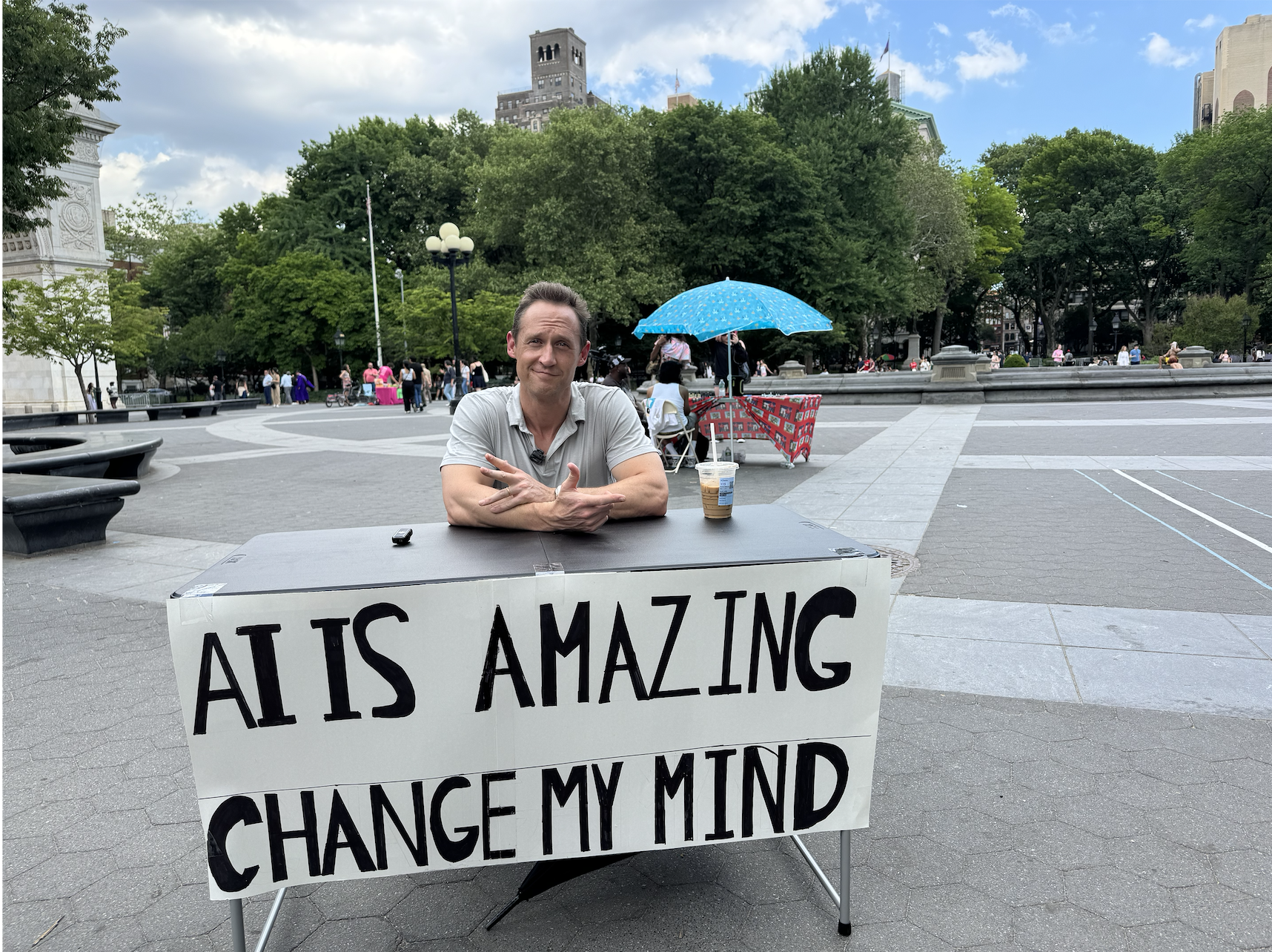
Me setting up shop in Washington Square. Do you see the folks in the peanut gallery gathering tomatoes???
I talked to someone in theater production who had real concerns about AI and creative work — the kind of concerns about what happens when tools start absorbing pieces of the creative process that used to belong to humans. But in the same conversation, she could point to moments where AI had been genuinely useful: planning shooting sequences in the park, figuring out how a crew should move between locations, solving logistical problems that would have been painful for a person to map manually. That contradiction matters, because the same person can be afraid of what AI does to their industry and grateful for what it does for their Tuesday afternoon.
I met a student who had opted out almost entirely because she wanted to develop her brain. Honestly, I respect that. I don't fully agree — I think working with AI can make you sharper if you do it right — but I respect the principle. There was integrity in it. I met an actor worried about deepfakes (also legitimate). And then I met a cook named Pumpkin who was worried about robotic cooks entering the kitchen. He told me he wouldn't hesitate to pour hot oil all over a robot cook to keep his job, which is a sentence I did not have on my bingo card for that day.
Even better, he had a tattoo of a cartoon dolphin across his shoulder whose caption read "I’m a baby because dolphins make me cry." A cook ready to defend his kitchen with hot oil and ready to weep at the thought of a dolphin, all in the same person. Later that afternoon, someone else told me one of the things they were most excited about in AI was decoding animal language. And I haven't stopped thinking about the cook since. Would the same man who'd defend his kitchen with hot oil embrace an AI that helped him finally understand a creature he loves enough to ink on his body? I don't know.
But I'm pretty sure I never would have asked that question if I had stayed in Boston.
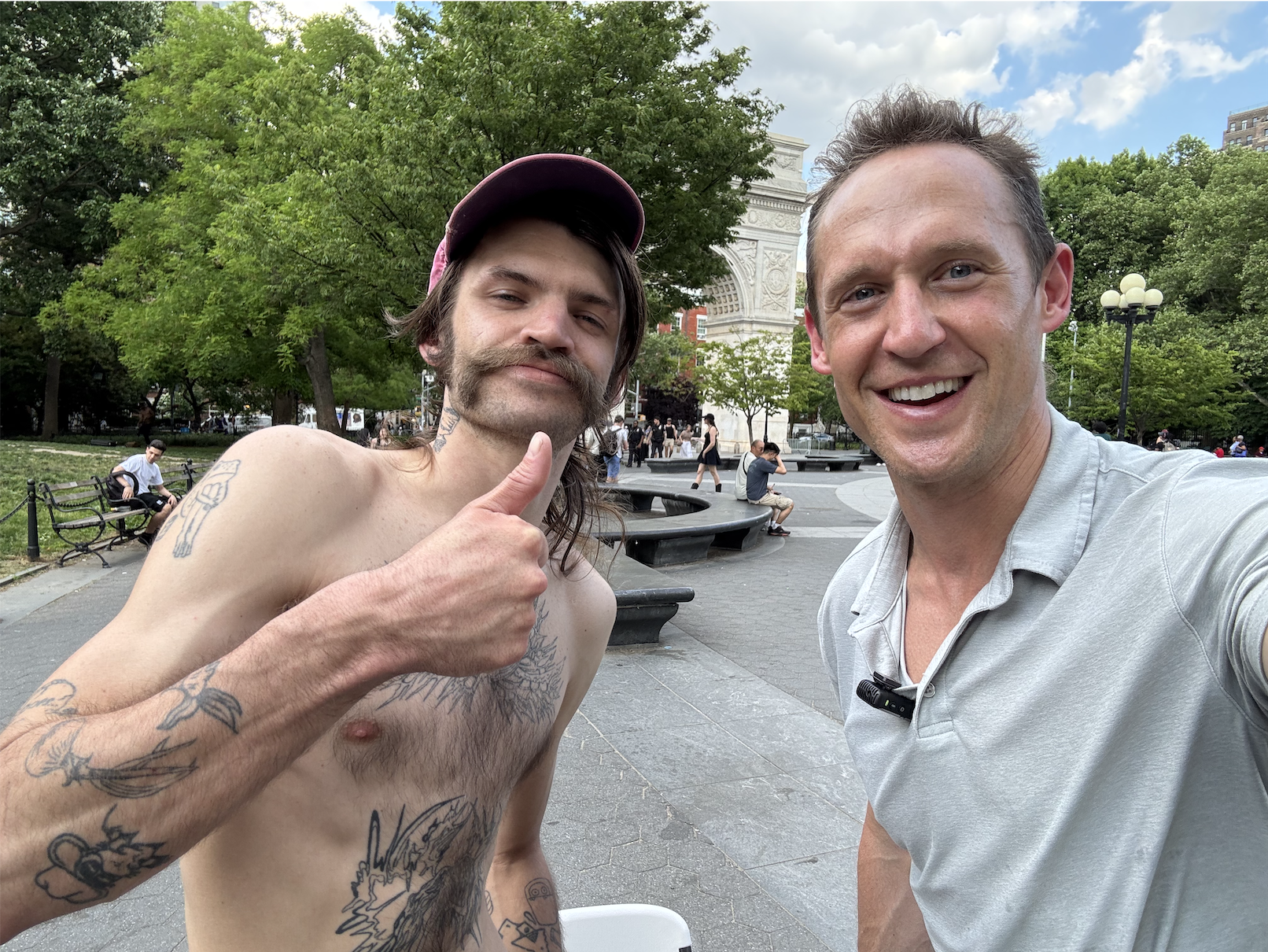
Pumpkin and I had an awesome conversation — coming to YouTube soon!
The market is not in the green room
Pew Research recently found that 47% of AI experts are more excited than concerned about the increased use of AI in daily life. Among the general public, that number is 11%. That's not a gap; that's a canyon! And if you spend all your time with experts, founders, executives, consultants, and AI-obsessed weirdos like me (and trust me, I am one of those weirdos!), you can accidentally convince yourself the world is where you are, when it very much isn't.
The market is not in the green room.
The future of this technology isn't being debated only on podcasts, panels, private dinners, and intimate rooms after keynotes. It's being negotiated by cooks, actors, students, teachers, parents, artists, retirees, and people with dolphin tattoos.
This is where I think a lot of us get AI wrong: we make people too simple. We ask, "are you pro-AI or anti-AI?" But real people aren't pro-AI or anti-AI. They're pro-their job, pro-their kid, pro-their craft, pro-their mother's retirement, pro-their future, pro-their ability to think — pro-dolphins, apparently. They’re pro-their-life.
That's why the danger of spending all your time around AI experts isn't that you become too optimistic. It's that you become too simple. You start talking about adoption curves when the person in front of you is talking about rent; you start talking about model capabilities when they're talking about their daughter's homework; you start talking about productivity when they're talking about whether their work will still mean anything. None of those concerns are solved by saying, "actually, the technology is amazing," even when it is. Maybe especially when it is.
Input can become camouflage
I believe in input. Deeply. I've written about attending SXSW, getting floored by Beeple’s daily discipline, the Ted Lasso writers' room, mindwriting, strange sparks, unexpected conversations. All the things. I am an input obsessive, and this is well-documented.
But input is not the same thing as contact with reality. Another podcast can feel like progress, another book can feel like learning, another dinner can feel like insight, and another intimate session with a legend can feel like the obvious choice — and sometimes it is. But sometimes it's the beautiful excuse. Sometimes the thing you need is not another idea from someone you admire; sometimes the thing you need is to stand in a park with a sign you're embarrassed to hold and let strangers tell you what you're missing.
Here’s the rule I came home with: if the comfortable option gives you inspiration and the uncomfortable option gives you evidence, choose evidence. Especially when the fear is not fear of harm, but fear of judgment: that very specific feeling of this might be awkward, people might think I’m weird, I might not know what to say, I might be exposed.
That kind of fear is often pointing at the thing that will teach you. It was for me: Dave Grohl would have given me a better name-drop, but Washington Square gave me better questions.
What are you trying to protect?
I keep thinking about Pumpkin: about his tattoos, about his love of dolphins, about the fact that the person who would defend his kitchen with oil might be the same person who weeps at the idea of finally understanding a creature he loves. That contradiction isn't a bug; that's what being human looks like.
Which is why the question I can't stop asking isn't "do you love AI or hate AI?" That question is too small. The better question is: what are you trying to protect? Your craft, your judgment, your job, your imagination, your ability to think, your humanity? And then, right next to it: what could AI help you love, build, understand, or protect more deeply?
So I'd love to hear from you: what's a human advantage you have that AI can't replicate? Reply and tell me. I'll send a surprise to my three favorite stories.
P.S. This is the question I'm living inside while writing The Human Advantage — not "what can AI do?" but "what becomes more valuable because AI exists?" Dave Grohl would have been incredible, but I'm glad I got on the plane.
Join over 37,147 creators & leaders who read Methods of the Masters each week.